Applying for a Master's in Europe from India: Practical Steps
Applying for a master's in Europe from India is more than just sending transcripts , it's about meeting country-specific requisites such as ECTS credits and precise motivational letters. Indian students often find themselves puzzled by European requirements that differ significantly from their own education system. Getting it right from the beginning sets the stage for everything that follows.
At NextDegreeAbroad, we have directly assisted over 2,000 Indian students to complete successful master's applications across 12 European countries.
What Is Applying for a Master's in Europe from India?
Europe applications ask for a motivation letter, ECTS credits, and sometimes both a university portal and a national portal, which is completely different from the marks-and-entrance-exam system most Indian students grew up with. The confusion is real, and it catches even strong applicants off guard.
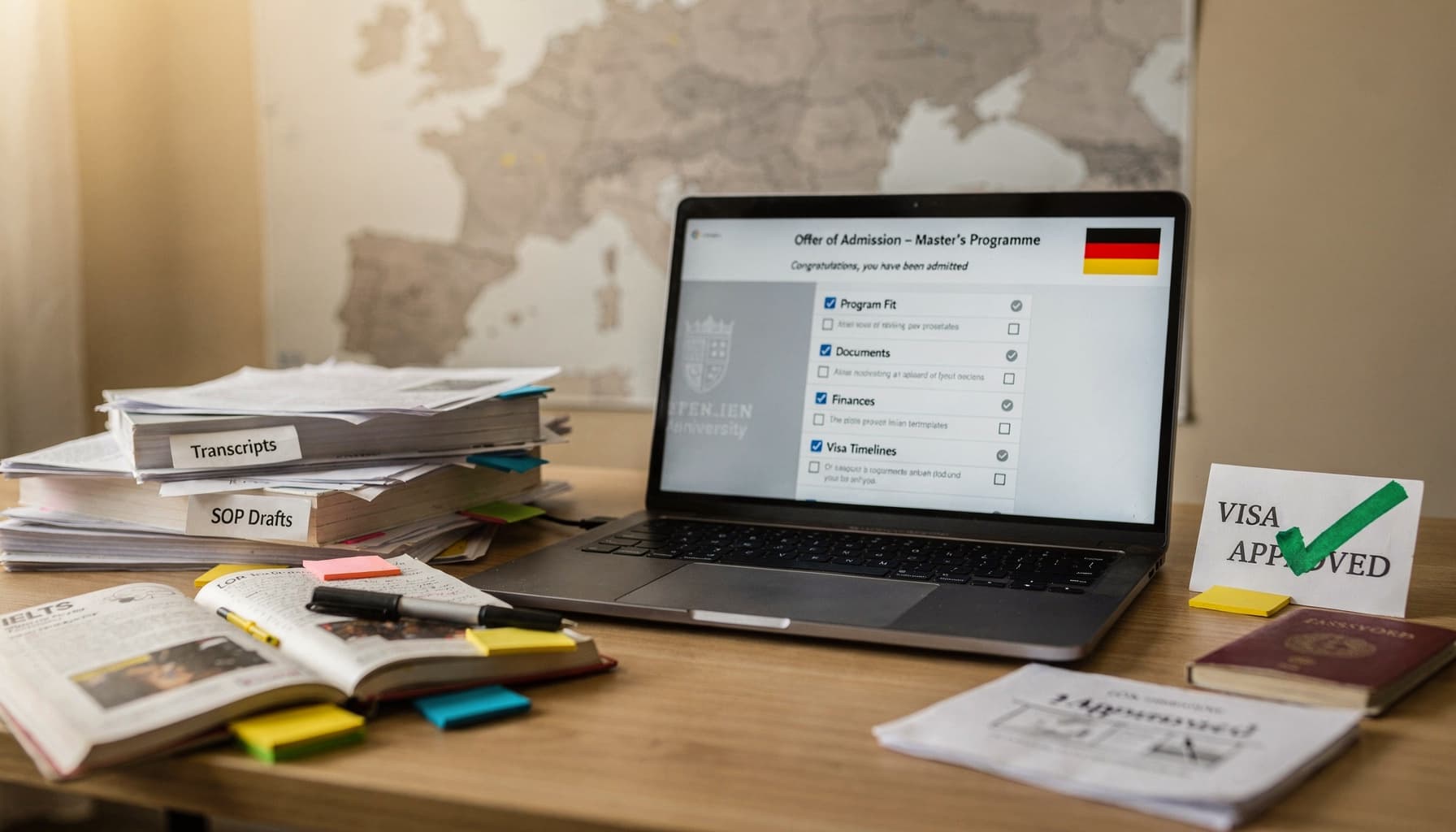
To apply for a master's in Europe from India, you move through six distinct stages, and each one has a hard dependency on the next. Build your timeline backwards from your earliest deadline.
- Shortlist countries and programs by language, tuition model, duration (1 year vs 2 years), and intake month
- Verify eligibility: degree equivalence, prerequisites, credit/ECTS expectations, and minimum grades
- Decide language proof route: IELTS/PTE, waiver, or program taught in English requirements
- Prepare application set: motivation letter, CV, transcripts, LORs, portfolio (if needed)
- Submit via university portal (and any parallel national portal where applicable) before department review dates
- Post-offer: accept, pay deposit if required, arrange finances, start visa file, and plan housing/pre-departure
The "best country" question depends on fees, visa processing speed, and language requirements, not a single ranking. Germany and the Netherlands offer low-tuition public university options for non-EU students. France has strong scholarship pipelines. Each country has different visa lead times, so confirm those before you shortlist.
European applications prioritize "fit" and thorough preparation. Unlike India, where aggregate scores and entrance exams carry most of the weight, European universities want to see that you genuinely understand why you're applying to that specific program. I've reviewed over 100 motivation letters with students from Ahmedabad, and the ones that get shortlisted are always the ones that clearly map prior academic work to the exact course modules. A weak prerequisite match, even with a strong GPA, can quietly kill an otherwise good application.
Expert Note: Many European universities require applicants to submit both program and country-specific documents on different web portals, so always cross-check requirements for each stage before submitting.
Key Takeaway: Compile a checklist of both university and national requirements at the very start to avoid missed steps and last-minute surprises.
Benefits of pursuing a master's in Europe for Indian students
If you're weighing the ROI of studying abroad, the real question is this: do you want a master's that can be completed in 1 to 2 years in a globally recognized system, plus a clear path to stay and work after graduation in several EU countries?
Academic and cultural advantages
European master's programs are built around the ECTS credit structure, which means your qualification is recognized across dozens of countries, not just the one where you studied. Many programs embed applied projects, industry theses, and international cohorts directly into the curriculum. That cross-cultural classroom experience builds communication skills that European employers actually test for during interviews.
When you shortlist programs, filter specifically for English-taught tracks, mandatory industry projects, and thesis options tied to real companies. A program without these features makes your post-graduation job search harder, not easier.
Post-study work opportunities
Several European countries offer defined post-study job-search routes, but the rules differ sharply by country, university type, and permit category. Germany typically runs a 2-year master's with its own residence permit pathway for graduates. Ireland's taught master's can finish in 1 year, with the Third Level Graduate Programme offering a separate job-search window.
What most people get wrong here is sequencing. Choose your country based on post-study permit length first, then pick the university. Align your intake month, graduation date, and that country's hiring seasons so you don't graduate into a permit dead zone before offers arrive.
Expert Note: The Netherlands issues a one-year "zoekjaar" permit for job seeking after graduation, but you must apply within three years, so track your timelines and gather documents well before your graduation date.
Key Takeaway: Always research and document post-study visa policies alongside your program shortlist so your job search period and visa deadlines align.
Eligibility Criteria to Apply for Masters in Europe from India
Are you about to pay application fees only to discover your degree, GPA, IELTS score, or missing APS certificate makes you ineligible for your target European university?
Before you shortlist a single program, build what I call an eligibility matrix: a one-page grid for every program that maps degree duration accepted, required prerequisite subjects, GPA conversion, language test minimums, and country-specific document gates. In my 100+ workflows with Indian students, this one step prevents the most expensive mistake applicants make.
Academic Requirements
European universities don't evaluate Indian degrees the same way. What matters is degree duration (3-year vs. 4-year), field relevance, and how your CGPA or percentage converts against their minimum threshold.
A candidate from Ahmedabad applied to programs in Germany and the Netherlands without checking degree equivalence. Several programs required a 4-year bachelor's or specific ECTS prerequisites, leading to rejections after paying fees. Once each program's eligibility was mapped subject-by-subject to the actual transcript, 10 applications became 5 fully eligible ones, resulting in 3 admits with zero rejections from basic eligibility mismatch.
Match your transcript to each program's prerequisite list, not just your overall percentage.
Language Proficiency
Most programs accept IELTS Academic, TOEFL iBT, or PTE Academic. Some universities allow an English-medium instruction letter, but don't assume yours qualifies without checking the specific program page.
What most people get wrong here is focusing only on the overall score. Per-band minimums matter just as much. A 6.5 overall with a 5.5 in writing can disqualify you from programs that require 6.0 in every section.
Check both overall and per-band minimums, then book a test date that fits the earliest application deadline. Mapping your academic qualifications and language scores to each program's actual requirements before applying has saved my students thousands in fees and months of wasted effort.
Expert Note: Some German universities ask Indian students for an APS certificate to verify academic documents, processing this can add at least four weeks, so plan well in advance.
Key Takeaway: Create an eligibility matrix with key requirements for each program to maximize your chances and avoid application rejections.
Step-by-Step Guide: How to Apply for Masters in Europe from India
Stuck between 12 different European portals, unclear deadlines, and a document list that changes by country, and you just want a clean step-by-step process to apply from India without missing anything?
Here's the framework that actually works. Treat your entire Europe application process as a two-lane pipeline. Lane 1 covers university-ready documents: SOP, LORs, transcripts, CV. Lane 2 covers visa-ready documents: financial proofs, accommodation plan, insurance, affidavits. Most students complete Lane 1 and only start Lane 2 after admission. That is exactly what creates visa delays and deferred intakes. Build both lanes in parallel from week one.
Researching Universities and Programs
Shortlisting is where the Europe admission process either gains momentum or collapses into confusion. Don't start with rankings. Start with hard filters: language of instruction, intake month, ECTS credit structure, accreditation status, employability outcomes, and total cost covering tuition plus living expenses.
Verify every requirement on the official program page only. Third-party aggregators go outdated fast, and one wrong document assumption costs you an entire intake cycle. In my experience working with students across Ahmedabad, a starting list of 10 universities trimmed down by hard filters around deadline, eligibility, language, and budget consistently lands at a clean shortlist of 6 programs worth your full energy.
For Indian students asking which European country is best, Germany , the Netherlands, and France consistently offer strong programs across engineering, business, and data science with varying tuition structures. Germany offers many public university programs at low or zero tuition. The Netherlands delivers English-taught programs with strong industry links. France sits in the middle with selective grandes écoles and competitive scholarships.
Document Preparation and Timelines
Work backwards from your earliest application deadline, not your latest. If your priority program closes in December 2025 for a September 2026 intake, your preparation window starts in March or April 2025 at the latest.
Week-by-week, the sequence looks like this: request official transcripts first since universities take 3 to 6 weeks, then approach recommenders early with a clear brief, then book your IELTS or PTE slot with a 6 to 8 week buffer before your first deadline. Germany-bound applicants need to account for APS certificate processing, which adds 4 to 6 weeks on top of standard timelines. Bank statements, ITR copies, and scholarship proofs should be staged before you receive your first admit letter, not after.
Two employees at an Ahmedabad IT services firm learned this the hard way. Tracking requirements across WhatsApp threads and email chains, they missed one program deadline and one VFS appointment window, forcing both to defer. Their fix was a single shared tracker with program links, backwards timelines, and two separate checklists for university and visa documents. Result: 6 applications submitted on time, 4 admits, 1 scholarship offer, and both students secured visa appointments for their intended intake.
Application Submission and Fees
Submission mechanics vary significantly across Europe. Some universities use their own portals, while others use centralized systems like Uni-Assist in Germany or Studielink in the Netherlands. Know which system applies before you upload anything.
Common rejection triggers are entirely avoidable. Wrong file format, missing signatures on official documents, and mismatches between your CV timeline and SOP narrative are the top three. Before hitting submit, run a pre-submit QA pass: check file naming conventions, confirm all PDFs are properly merged, and verify your passport details are consistent across every document. Pay international application fees only through official payment gateways listed on the university website. Europe application fees typically range from 0 to 100 euros per program depending on country and institution type.
Track Applications and Communications
I manage a shared tracker for every student I work with, and the columns never change: deadline, submission date, missing documents, decision status, and deposit date. When you're juggling 6 applications across Germany, France, and the Netherlands at the same time, one missed email can cost you a seat. One email thread per university, no exceptions.
Response time to university clarification emails matters more than most applicants realise. Admissions offices flag unresponsive applicants, so reply within 24 hours to any request for additional documents or interview scheduling. Europe university application deadlines for 2026 intakes are already live on most portals, and interview invitations often come 4 to 8 weeks after submission. Keep your tracker updated in real time so you're never caught off guard by a deposit deadline or a conditional offer requiring a fast turnaround.
Running your document prep and applications in parallel genuinely cuts weeks off your visa timeline. I've seen students lose confirmed seats simply because they treated these as sequential steps instead of simultaneous ones.
Expert Note: Most centralized application portals in Europe allow you to edit your submission only until you hit "submit", after which only corrections via emailed requests are accepted, review thoroughly before final submission.
Key Takeaway: Set daily reminders to check your email and update your tracker immediately for each new communication from universities or embassies.
Essential Documents When You Apply for Masters in Europe from India
Are you sure your transcripts, SOP, LORs, and IELTS score report match the exact format your target European university portal accepts, or are you about to lose weeks to avoidable "document rejected" emails?
One IT professional applying to MS Data Science programs in Germany and the Netherlands learned this the hard way. His portal flagged the application as "incomplete" because he uploaded only consolidated transcripts without a grading scale, and LORs that lacked official letterhead and referee contact details. After rebuilding the entire document pack with attested transcripts, a grading legend, and two academic LORs on institutional letterhead, resubmission was accepted in five days. That fix saved him one full application cycle, six months.
Here's exactly what your document set needs to look like.
Transcripts and Degree Certificates
Most European universities expect a specific bundle from Indian applicants, not just whatever your college issues by default. You'll need semester-wise marksheets or official transcripts, a consolidated transcript if your university issues one, your degree certificate or provisional certificate, and a grading scale or class rank note.
What gets rejected constantly is the missing grading legend. German and Dutch portals flag applications where evaluators can't interpret a 7.8 CGPA or a percentage without context. Before you hit submit, confirm whether your target program requires attested copies, certified translations, or a grading legend uploaded as a separate file.
I've seen students spend weeks fixing this after submission, which delays everything. Build a "portal-proof" PDF set where every document is text-searchable, not a scanned photo. Add a one-page Document Index as page one, naming each file, its issuing authority, date, and attestation status. Admissions teams can verify completeness in under 60 seconds, and you cut back-and-forth emails by at least 3 to 4 rounds.
Here's a quick reference for what each document category must include:
- Transcripts and degree certificates: semester marksheets or official transcripts, consolidated transcript if issued, degree or provisional certificate, grading scale or legend, certified translation if required
- SOP: program-specific motivation, academic readiness evidence, module or research fit, realistic career plan, country rationale in one to two lines only
- LOR: on letterhead, signed, dated, referee designation, institutional email or phone, specific examples and comparative ranking if possible
- English test scores: IELTS or TOEFL score report or TRF, minimum overall plus section cutoffs, validity window, waiver policy proof if claiming exemption
Statement of Purpose (SOP)
EU admissions panels are not impressed by generic enthusiasm. What they evaluate is academic readiness, your motivation for the specific curriculum, and a career plan that connects to local industry or research groups in that country.
Write one paragraph that explicitly maps two to three of your past projects or courses to two to three modules listed on the target program page. That specificity signals you've done real research, not just copy-pasted an SOP template. Programs in France, the Netherlands, and Germany receive thousands of applications; vague "Europe has great opportunities" statements get filtered out fast.
Letters of Recommendation (LOR)
A strong LOR for European portals is not just a nice letter. It needs institutional letterhead, the referee's designation, an official email address, the relationship context, and specific evidence like your ranking in class, project outcomes, or scores.
Brief your referees properly. Give each one a five-bullet achievement sheet covering your most relevant work, and tell them exactly how each university wants the LOR submitted, whether that's a direct upload or a referee email link the portal generates. Different universities across Germany, France, and the Netherlands handle this differently, so check each portal individually.
English Language Test Scores (IELTS/TOEFL)
Universities don't just set an overall band requirement. Many programs specify minimum section scores too, and missing a sub-score cutoff can disqualify an otherwise strong application.
I've seen students with an overall IELTS 7.0 get rejected because their Writing was 6.0 and the program needed 6.5 in every section. Some programs do waive English tests for applicants with prior English-medium education, but this is strictly program-specific, not a blanket country-wide rule. Don't assume a waiver applies to you without written confirmation on the program admissions page. Check whether the portal requires you to upload the full Test Report Form PDF or simply enter a TRF number, because these are two different processes and submitting the wrong one causes delays.
Expert Note: Always upload text-searchable PDFs for transcripts and certificates, as many European portals auto-scan documents and can reject blurry or non-searchable files outright.
Key Takeaway: Prepare all documents in clearly labeled, text-searchable PDFs with a grading scale and document index to avoid delays or rejections.
Ready to stop doing this manually? Book a Free Consultancy. Book a free consultation and get your automation roadmap in 48 hours.