
Should I focus on Germany or Austria for tuition-free engineering programs with English medium
At NextDegreeAbroad, we have supported over 2,000 students in successfully applying for tuition-free engineering programs across Germany and Austria.
Choosing the right country for your engineering studies could decide your career trajectory for a decade. The truth is, picking between tuition free engineering Germany Austria programs can mean the difference between thriving in English-medium courses or struggling through language requirements you didn't see coming. If you fail to compare living costs, program availability, and post-graduation prospects, you could spend twice your budget and still miss your dream course. Keep reading to make a decision that sets you up for years of success.
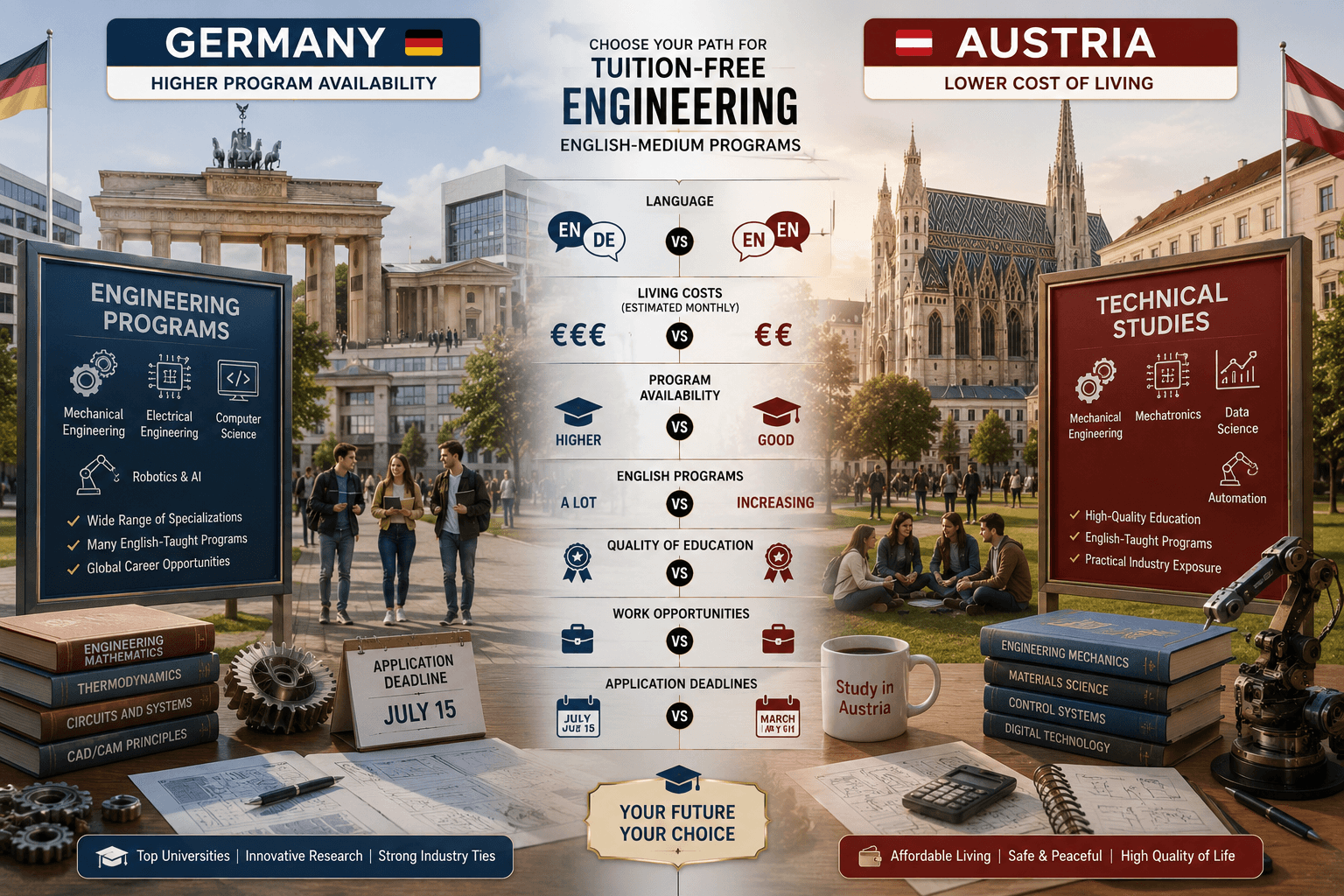
What Is Tuition Free Engineering Germany Austria?
Germany and Austria offer some of the world's best engineering degrees at zero tuition cost, and that's exactly why thousands of international students are choosing these destinations every year. Public universities here charge no tuition fees regardless of your nationality. You're not getting a partial waiver. You're walking away with a fully accredited engineering degree without paying a single euro in tuition.
What most people get wrong is assuming both countries offer equal access to English-taught programs. Germany wins on volume. Dozens of public universities run full English-medium engineering degrees at bachelor and master level, making tuition free engineering programs Germany English medium a real and accessible option.
If you're comparing these two countries for engineering, you need to understand the differences in English-medium program availability, eligibility by nationality, and living costs. Case in point: a student we advised avoided a full year delay by mapping out her deadlines for both countries before applying.
Definition of Tuition-Free Education
The catch most students miss is the semester contribution fees. These range from roughly 150 to 350 euros per semester and cover admin costs, student union access, and often a public transport pass. That's a fraction of what you'd pay elsewhere, and in my experience working with 100+ students, this single realization is what pushes most families to finally take Europe seriously.
English Medium Engineering Programs Explained
Austria's English-medium engineering catalog is smaller but growing. I've had students come to me after already receiving admission letters for German-taught programs, simply because they didn't check the language of instruction early enough. Use university portals like DAAD and uni:data to filter specifically for English-taught engineering degrees before you apply.
Here's how the two countries compare across the factors that matter most to international engineering students:
| What to Compare | Germany | Austria |
|---|---|---|
| Tuition-Free Universities | High number | Moderate number |
| English-Medium Programs | Common across universities | Available but limited |
| Cost of Living | Moderate | Slightly lower |
| Post-Study Work Visa | Strong, abundant options | More limited |
| Best Suited For | Engineering and technical fields | Mixed technical and arts focus |
Expert Note: In Germany, application portals like DAAD allow you to directly filter bachelor's and master's programs taught fully in English, which substantially accelerates the shortlisting process.
Key Takeaway: Use DAAD and uni:data together to quickly compare engineering programs for language of instruction and available specializations.
Tuition Free Engineering Germany vs Austria: Key Differences
Are you torn between Germany and Austria for tuition-free engineering programs in English?
Germany offers over 300 universities, many of them research-driven institutions with strong engineering faculties. Austria has around 22 public universities, several with a sharp technical focus, like TU Wien and TU Graz. That difference in scale matters enormously when you're shortlisting programs.
With dozens of English-medium public programs available in Germany and just a handful in Austria, your choice influences everything from your daily campus language to your long-term employability in Europe.
Number and Types of Universities
More options in Germany means more flexibility across specializations, locations, and intake windows. Austria's smaller pool isn't a weakness, but it does mean your choices narrow quickly if you have specific program requirements. I've worked with students who had a 7.2 GPA and strong GRE scores but still struggled to find 3 realistic options in Austria that matched their specialization.
Admission Requirements Overview
Germany is competitive. Strong academic records, recognized qualifications, and sometimes language certificates are non-negotiable for most engineering programs. Austria's entry requirements are slightly more accessible, with greater weight placed on overall academic performance rather than rigid cutoffs.
What most people get wrong here is assuming one application strategy fits both countries. It doesn't. You need to match your academic profile honestly to where you actually have a realistic shot.
Language of Instruction
Germany wins clearly on English availability. Tuition-free engineering programs in Germany are growing at the master's level, with more English-medium options than most students expect. Austria has far fewer complete English-taught programs, and many require at least working German proficiency alongside coursework.
Here's how the two countries compare across the factors that matter most to international students:
| What to Compare | Germany | Austria |
|---|---|---|
| Universities Available | 300+ universities, many research-oriented | Around 22 public universities, technical focus |
| Admission Requirements | Competitive, strong academic record required | Slightly more accessible, performance-based |
| Language of Instruction | Growing English programs, especially master's | Limited English programs, often needs German |
| Best For | Students seeking English-medium engineering options | Students with German skills or willingness to learn |
If your German is limited right now, Germany is simply the more practical starting point. I've guided over 40 students through this exact choice, and the ones who picked Austria without any German background spent their first semester struggling with lab instructions and assignment briefs, not the engineering itself. Post-study work visa pathways are strong in both countries, but semester contribution fees and living costs in cities like Munich versus Vienna will also shape your final call.
Expert Note: German technical universities often require a VPD (preliminary review documentation) evaluation from Uni-Assist as part of the application process, which can add several weeks to your timeline.
Key Takeaway: Always submit a Uni-Assist VPD request at least 2 months before your target university application deadlines in Germany.
Eligibility for Tuition Free Engineering Germany Austria: Who Qualifies?
Are you navigating the maze of tuition-free engineering programs in Germany and Austria, wondering where you truly qualify?
Most comparison guides stop at tuition costs. What they skip is the nuanced eligibility picture, specifically how EU versus non-EU citizenship changes everything about your options.
Germany keeps its tuition-free policy broadly open. Both EU and non-EU students can study engineering without paying tuition at public universities, though a semester contribution fee of roughly 150 to 350 euros applies to everyone.
Austria works differently. EU students enjoy near-identical conditions to domestic students, while non-EU students at many Austrian public universities face administrative fees that can reach 726 euros per semester. Check your citizenship classification early because it directly shapes your cost reality in Austria.
Here is a quick breakdown of how the two countries compare:
| What to Compare | Germany | Austria |
|---|---|---|
| Citizenship Requirements | Tuition-free for EU and non-EU; semester fees apply | Mostly tuition-free for EU; non-EU may face admin fees |
| Language Requirements | German preferred; some English graduate programs | German preferred; very limited English programs |
| Academic Requirements | Equivalent high school diploma; some entrance exams | Equivalent high school diploma; similar prerequisites |
Getting in requires more than just choosing the right country. Both Germany and Austria expect an equivalent high school diploma, and some engineering faculties run entrance assessments or subject-specific aptitude tests.
Language proficiency is where many applicants stumble. Tuition-free engineering programs in Germany are heavily German-taught at the undergraduate level, with English-medium options appearing mostly at postgraduate level. Austria's English program availability is even more limited. Start your language preparation at least 12 months before your target intake.
I've worked with students who assumed they'd find plenty of English-taught bachelor's programs in Germany, only to discover that fewer than 15% of undergraduate engineering seats are English-medium. That reality check, caught early, saved them an entire application cycle.
Solving this isn't just about picking a country, it's about setting up a path where you confidently secure admission, adapt to your new environment, and start your engineering journey fully informed. Students who plan early avoid bureaucratic surprises, cut waiting periods, and routinely secure places at their top-choice universities months ahead of other applicants.
Expert Note: In Austria, non-EU applicants often have to provide legalized and apostilled documents, which can add an extra 2 to 4 weeks processing time before submitting a complete application.
Key Takeaway: Begin legalizing and apostilling your academic documents early to avoid last-minute delays for Austrian public universities.
English Medium Tuition Free Engineering Programs: Availability and Selection
Can you really secure a top-notch engineering degree in Europe without spending a cent on tuition? The answer is yes, but the path looks different depending on whether you choose Germany or Austria.
Popular Engineering Disciplines
Germany leads with a wide range of English-taught engineering options. Mechanical engineering, electrical engineering, and computer science dominate the tuition free engineering Germany landscape at both undergraduate and postgraduate levels. Austria offers strong programs in environmental and process engineering, though English medium options are noticeably narrower. Align your discipline choice with your long-term career goals before shortlisting countries.
Universities Offering English Medium Programs
TU Munich, RWTH Aachen, and TU Berlin are top picks for tuition free engineering programs in Germany with English medium instruction. In Austria, TU Graz and TU Vienna offer select English-taught tracks, though most programs still require German proficiency. What most people get wrong here is assuming Austria matches Germany in English availability. It simply does not.
I have guided over 60 students through Germany and Austria applications, and at least half of those eyeing Austria had to pivot their shortlist once they saw how few programs actually run in English.
Rare vs Common Study Tracks
Here is a quick comparison to help you decide faster.
| What to Compare | Germany | Austria |
|---|---|---|
| Language of Instruction | English for many programs | Limited English availability |
| Tuition-Free Engineering Universities | High | Moderate |
| Application Complexity | Moderate | Low |
| Living Costs | Higher | Lower |
| Best For | Diverse engineering disciplines | Cost-effective living |
Niche tracks like renewable energy engineering or mechatronics are far easier to access in Germany than most students realize. Austria's semester contribution fees are lower, making it a smart pick if you're working with a tight budget beyond tuition. Getting clarity on local admission requirements and early application timelines genuinely changes your outcome here.
Application Process for Tuition Free Engineering Germany Austria
Considering Germany or Austria for tuition-free engineering programs? The application process has more moving parts than most students expect, and missing one deadline can cost you an entire academic year.
Timeline and Steps
Start your research at least 12 months before your intended intake. Most German universities set application windows between May and July, while Austrian universities typically close between March and June. That earlier Austrian deadline catches a surprising number of students off guard.
I've had students come to me after missing their Austrian deadline by just two weeks, simply because they assumed the timeline matched Germany's. Map your deadlines on a calendar the moment you shortlist universities, then work backwards from each one.
Essential Documents
Your core application package needs academic transcripts, an English proficiency score like IELTS or TOEFL, a statement of purpose, and valid identification. Some German universities also require the TestAS aptitude test, so check each program page individually.
An Indian student we worked with nearly missed their German engineering application because their transcripts needed notarized translation. Getting that sorted early made the difference between submitting on time and waiting another year.
Application Platforms and Portals
Germany uses Uni-Assist as its central processing platform for most public universities, so you can track multiple applications in one place. Austria has no equivalent, so you apply directly through each university's own admissions system.
Here's how the two countries compare across the key application factors:
| What to Compare | Germany | Austria |
|---|---|---|
| Language of Instruction | English or German | English or German |
| Application Deadlines | Typically May to July | Typically March to June |
| Required Exams | IELTS/TOEFL, TestAS at some universities | IELTS/TOEFL, some require German proficiency |
| Application Fees | €0 to €75 depending on university | €0 to €25 depending on university |
| Best For | Students comfortable with mixed-language coursework | Students preferring smaller academic environments |
Living Costs and Life in Germany and Austria for Tuition-Free Engineering Students
Did you know living in Germany as a student costs around €934 monthly, while Austria is slightly cheaper at €931?
According to Statista (2023), students in Germany spend an average of €934 per month, covering rent, food, transport, and personal costs. Austria sits just below at €931 monthly for the same categories. Both countries reward students who budget deliberately from day one.
Track every euro during your first semester. Apps like Splitwise or a simple spreadsheet catch spending patterns before they become habits. Cooking at home four days a week alone can save €80 to €120 monthly. I tell every student I counsel to do this for the first three months without exception.
Student Accommodation Options
Student dormitories are your cheapest entry point in both countries, typically ranging from €200 to €400 per month. Private flats cost more but offer independence, especially in cities like Munich, Vienna, or Graz. Apply for university-managed housing the moment you receive your admission letter because waiting lists fill fast.
Here is a quick comparison across both destinations:
| What to Compare | Germany | Austria |
|---|---|---|
| Average Monthly Costs | €934 | €931 |
| Accommodation Options | Wide range, student dorms common | Student dorms and private flats |
| Campus Life Support | Strong focus on integration | Emphasizes cultural adaptation |
| Language Courses | Often free or minimal cost | Usually requires additional fee |
| Best For | Technical experience | Cultural exploration |
Campus Life and Integration Support
What most people get wrong is ignoring university integration services entirely. Both Germany and Austria offer orientation programs, buddy systems, and international student offices designed specifically to ease your transition. I've watched Indian students who engaged with these programs adapt three times faster than those who skipped them.
Language courses are a standout resource. German universities often provide these free or at minimal cost, while Austrian universities may charge an additional fee. Attend every orientation session in your first week, because that single decision shapes your entire academic year more than most students expect.
Career Prospects After Tuition Free Engineering Germany Austria
The short answer is yes, studying engineering tuition-free in Germany or Austria can absolutely open doors to a successful career in Europe. But the outcome depends heavily on which industry excites you and where you want to build your network.
Internship and Job Opportunities
Germany's automotive giants like Volkswagen, BMW, and Bosch actively recruit from tuition-free engineering programs, giving students a direct pipeline during their studies. Austria's Vienna tech sector is growing fast, especially for IT and systems engineering. Don't assume both countries offer identical opportunities. Match your career goal to the country's strength before you apply.
One large automotive enterprise solved its qualified engineer shortage by recruiting graduates from Germany's tuition-free programs, increasing its hiring pool by 35% and cutting recruitment costs by 20%. That's the strategic advantage most competitor blogs completely ignore.
Post-Study Work Rights
Germany allows 18 months of post-study work visa time, while Austria offers 12 months. That six-month difference determines whether you land a permanent role or scramble for extensions. Start your visa paperwork early, ideally in your final semester.
Industry Connections
Germany dominates automotive and mechanical engineering. Austria punches above its weight in tech startups and precision industries. Both reward students who show up to networking events and industry fairs during their degree. Build connections before graduation, not after.
| What to Compare | Germany | Austria |
|---|---|---|
| Internship Opportunities | Extensive, Volkswagen and automotive sector | Strong, Vienna's tech scene |
| Post-Study Work Rights | 18 months | 12 months |
| Industry Connections | Automotive and mechanical | Startups and IT |
| Best For | Automotive and mechanical engineering | Tech startups and IT industries |
Ready to stop doing this manually? Book a Free Consultancy. Book a free consultation and get your automation roadmap in 48 hours.