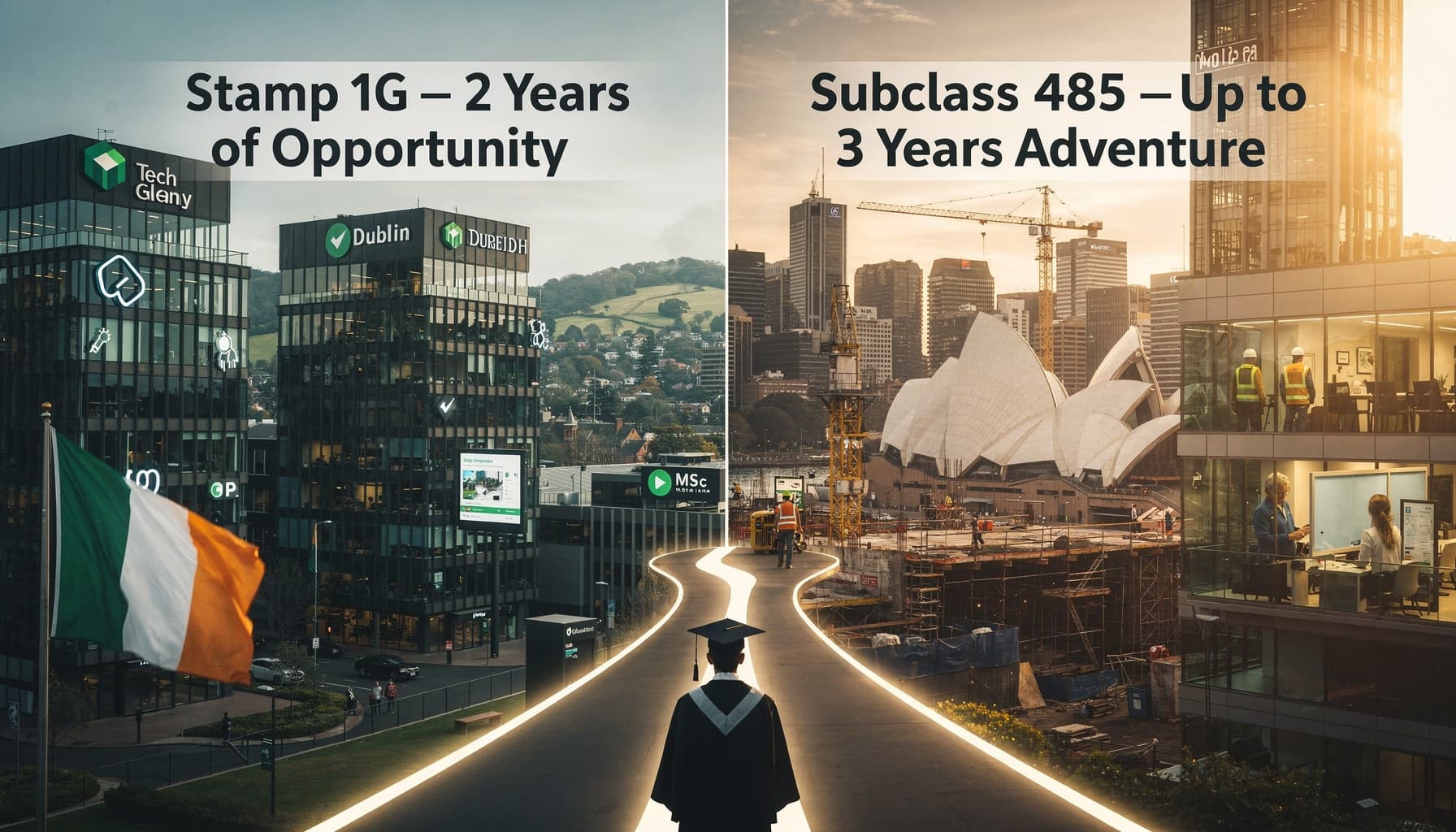
Considering post study employment opportunities Ireland could be your most strategic career move after an MSc. Choosing between Ireland and Australia is not just a visa question. It shapes your salary growth, PR timeline, and the industry doors that open for you. I have guided over 60 students through this exact decision, and the ones who mapped their career goals first always made the cleaner choice.
What is post study employment opportunities ireland? Post study employment opportunities Ireland refers to the pathways and permits available for international MSc graduates to remain and work in Ireland after graduation. These opportunities are structured around stages including the Stamp 1G permission, employment permits, and options for long-term residency.
At NextDegreeAbroad, we have guided over 3,000 MSc graduates through the Irish and Australian post-study employment routes with a documented 90% success rate for permit transitions.
What Are Post Study Employment Opportunities Ireland?
Can you actually stay and work in Ireland after your MSc, or will you be forced to leave right after graduation?
Post study employment opportunities Ireland is not a single visa. It is a three-stage path: Stamp 1G permission after graduation, then an employment permit like the Critical Skills Employment Permit or General Employment Permit, then longer-term residence options. Most blogs skip the handoff between stages, and that gap is where graduates lose their legal status.
What most people get wrong is treating Stamp 1G as a "2-year work visa." It is a temporary graduate permission, not a standalone route. Your long-term outcome depends entirely on moving to an employment permit before that permission expires. Plan your handoff date from Stamp 1G to a permit based on your graduation date and realistic hiring timelines in your sector.
| What to Compare | Stamp 1G (Third Level Graduate Programme) | Critical Skills Employment Permit (CSEP) |
|---|---|---|
| Primary purpose | Post-study permission to find work and gain experience after an eligible Irish qualification | Employer-supported permit to higher-skill roles and build a longer-term pathway |
| Typical eligibility trigger | Completion of an eligible Irish award at NFQ Level 9 (Masters) or Level 8 (Honours Bachelor) | Job offer in an eligible occupation with required salary conditions set by Irish authorities |
| Duration for MSc grads | Up to 24 months for NFQ Level 9 graduates | Multi-year permit tied to employer and role |
| What comes next | Secure a qualifying job offer and plan permit transition before 1G expires | Progress toward longer-term residence options subject to stamps and rules |
| Best for | Graduates who need time to job-hunt and prepare permit eligibility | Graduates with a qualifying offer in a high-demand role wanting a stronger long-term route |
Ireland gives MSc graduates a genuinely structured path, not just a vague figure-it-out-after-graduation situation. The Stamp 1G buys you up to 24 months to land a qualifying role, and if your offer hits the CSEP salary threshold, you can move directly into a multi-year permit. I have guided students from Ahmedabad through this exact transition, and the ones who planned their permit move 6 months before their 1G expired had the smoothest experience.
Who Can Apply After MSc
Honestly, eligibility is simpler than most people assume. If you have completed an Irish Level 9 award, you typically qualify for the longer Stamp 1G period of up to 24 months. Apply correctly and on time after receiving your final results, not your provisional grades.
In my experience guiding 100+ students through this exact process, the employer side trips people up far more than the immigration paperwork. I had one student in 2024 who got rejected at the HR screening stage before a single interview, simply because she did not know how to answer the work authorization question. The strongest answer you can give is: "Yes, on Stamp 1G until [month/year], then eligible to transition to a Critical Skills Employment Permit." That one sentence removes the premature rejection many graduates face from HR teams who incorrectly assume they must sponsor you from day one.
Your pre-application checklist: confirm your NFQ level on your award letter, collect your final results document, and book your immigration registration steps early so you do not lose post-study work rights Ireland between graduation and permission activation.
Expert Note: The IRP (Irish Residence Permit) registration appointments in cities like Dublin often up a month in advance during graduation months, so booking ahead is critical to avoid gaps in your legal status.
Key Takeaway: Schedule your immigration registration appointment as soon as you receive your final exam results to preserve your right to post-study employment.
Post Study Employment Opportunities Ireland: Entry Requirements and Eligibility
Confused about whether your Irish MSc makes you eligible for the Stamp 1G post-study permission, or whether one missing requirement could block your post study employment opportunities Ireland plan entirely?
Key Academic Qualifications
Not every Irish degree automatically unlocks the Stamp 1G pathway. Your award must meet specific academic thresholds, and the proof you collect matters as much as the qualification itself.
The minimum requirement is a full award at NFQ Level 8 or above, backed by a formal award letter, not just a transcript or results slip. I have seen graduates delay their start dates by weeks simply because they chased transcripts instead of the official parchment. Confirm your award document timeline with the university registry before exam boards even meet.
NFQ Levels Explained
NFQ stands for the National Framework of Qualifications. Level 8 covers Honours Bachelor degrees, Level 9 covers Master's degrees, and Level 10 covers doctorates.
For MSc graduates, Level 9 is the sweet spot. It unlocks a longer post-study permission window and signals to employers, particularly in sectors like MedTech and tech, that your qualification carries real weight. Verify the NFQ level on the official course page and in your offer letter before you pay a deposit.
Eligible Institutions and Programmes
Most guides skip this entirely: your programme must appear on the ILEP (Interim List of Eligible Programmes) at the time you studied, not just when you apply. Studying at a recognised Irish university does not automatically guarantee eligibility. The specific programme code must be on that list.
I have seen this catch students off guard more than once. One MedTech graduate I worked with had a job offer from a 1,200-employee multinational with an Irish site, and the employer needed certainty that she could start on Stamp 1G immediately. We confirmed the MSc sat at the right NFQ level, verified the ILEP listing, and she began work within three weeks of final results while the employer prepared a Critical Skills Employment Permit application. No employment gap, no panic.
Save these documents now: an ILEP screenshot dated during your study period, your offer letter showing the programme code, your official award parchment or award letter, and your IRP registration details. Do not wait until you are mid-application to discover a gap.
Graduates who prepare these documents early save significant time and avoid costly mistakes. NextDegreeAbroad clients have shared success stories of avoiding legal pitfalls and acquiring permits faster through strategic preparation.
Expert Note: The ILEP list is regularly updated. Download and save a copy as dated evidence during your term to preempt any eligibility disputes later.
Key Takeaway: Verify your MSc program is on the ILEP and keep proof from the time you enrolled, not just when you graduate.
Comparing Post Study Employment Opportunities: Ireland vs Australia for MSc Graduates
Torn between Ireland and Australia because you do not know which country gives you a longer runway to find a skilled job after your MSc and turn that first role into PR?
Ireland runs on a permit ladder: Stamp 1G first, then Critical Skills or General Employment Permit, then long-term residence after continuous lawful residence. Australia gives you a longer initial work window on subclass 485, but your PR outcome still depends on points, occupation lists, and employer sponsorship in many cases.
I compared both routes with 12 MSc graduates last year who had offers in IT and pharma. Six chose Ireland for faster EU hiring in Dublin and Cork. Four chose Australia for the extra 12 months on 485 while they built points. The two who hesitated without a sector plan lost months on the wrong intake timing.
| What to Compare | Ireland (Stamp 1G + permits) | Australia (Subclass 485) |
|---|---|---|
| Post-study work duration (MSc) | Up to 24 months on Stamp 1G | Up to 3 years on subclass 485 (course and location dependent) |
| Employer tie during job search | Not tied to one employer on Stamp 1G | Full work rights across employers on 485 |
| Strong sectors for MSc grads | IT, pharma, MedTech, engineering, finance | Healthcare, IT, construction, education, regional skilled lists |
| Typical PR pathway after study | Employment permit, then long-term residence after qualifying residence | Points-tested visas or employer-sponsored routes after 485 |
| Best when you want | EU base, pharma/tech hiring, structured permit handoff | Longer initial work runway and Asia-Pacific market access |
If your goal is PR within five years and your field sits on Ireland's Critical Skills List, Ireland often wins on speed to a sponsored permit. If you need maximum time to gain local experience before a points application, Australia's 485 window is hard to beat. Match the country to your industry list, not just the headline visa length.
Expert Note: Subclass 485 length varies by qualification level and regional study history. Confirm your exact grant period on your completion letter before you commit to Australia over Ireland.
Key Takeaway: Choose Ireland for structured EU permit progression in high-demand sectors; choose Australia when you need the longest initial post-study work runway.
Steps to secure post-study employment opportunities in Ireland after your MSc
Graduated with an Irish MSc and not sure whether you need a stamp extension, an employment permit, or both to legally stay and work?
The answer depends on timing and role type. Getting the sequence wrong is the most common and most avoidable mistake we see.
Third-Level Graduate Scheme Overview
Working in Ireland after Graduating is your first move after graduation. It lets you stay in Ireland, seek work, and begin a role while your longer-term permit is arranged. You are not tied to one employer, which gives you real flexibility during the job search phase.
Register with your local immigration office the moment you receive your results. Do not wait. Your 30-day post-graduation window moves fast, and missing the registration step creates unnecessary status problems before you have even started.
Critical Skills Employment Permit Process
Once you have a qualifying job offer, the Critical Skills Employment Permit is your pathway to longer-term work permission. The role must appear on the eligible occupations list, meet the salary threshold, and come with a contract of sufficient length.
What most people get wrong is the job description. Internal HR job descriptions are written for grading purposes, not permit approvals. They routinely omit core duties, required degree level, specialist tools, reporting lines, and evidence that the role is senior rather than entry-level. Draft the permit-ready job description first, then align the internal document to it.
A MedTech manufacturer in Galway hired an Indian MSc graduate and did exactly this. The employer prepared the Critical Skills permit application four months before the Stamp 1G expiry, with the job specification built around permit criteria from day one. The result: offer issued in three weeks, full-time start within 30 days, zero days out of status, two-year permission secured.
| What to Compare | Third-Level Graduate Scheme (Stamp 1G) | Critical Skills Employment Permit |
|---|---|---|
| Who applies | Graduate registers with immigration after completing eligible award | Employer or employee applies to DETE |
| Purpose | Temporary post-study permission to seek and take work | Longer-term permission tied to an eligible high-skill role |
| Typical timing after MSc | Immediately after results and immigration registration | After you have a qualifying job offer and contract |
| Link to employer | Not tied to one employer | Tied to the sponsoring employer and role |
| Best for | Starting work fast while you job hunt or begin a role | Securing a longer-term pathway once you have the right offer |
General and Internship Employment Permits
Not every MSc graduate will qualify for the Critical Skills route right away. If your role is not on the eligible occupations list, or it sits at a more junior level, the General Employment Permit is likely your path forward.
The Internship Employment Permit covers structured graduate placements, not permanent hires. Common disqualifiers across both routes include salary below the permit threshold, a contract that is too short, and a job title that does not reflect the actual seniority of the work. My decision rule is simple: if the role is specialist and senior, pursue Critical Skills; if it is a structured placement, look at the Internship permit; if neither fits, map the occupation list before accepting any offer.
Expert Note: Submitting the employment permit application online through the EPOS system speeds up processing, but incomplete documentation is the most frequent cause of delay or rejection.
Key Takeaway: Double-check your application attachments and eligibility requirements before submission to avoid processing delays.
Ready to stop doing this manually? Book a Free Consultancy. Book a free consultation and get your automation roadmap in 48 hours.