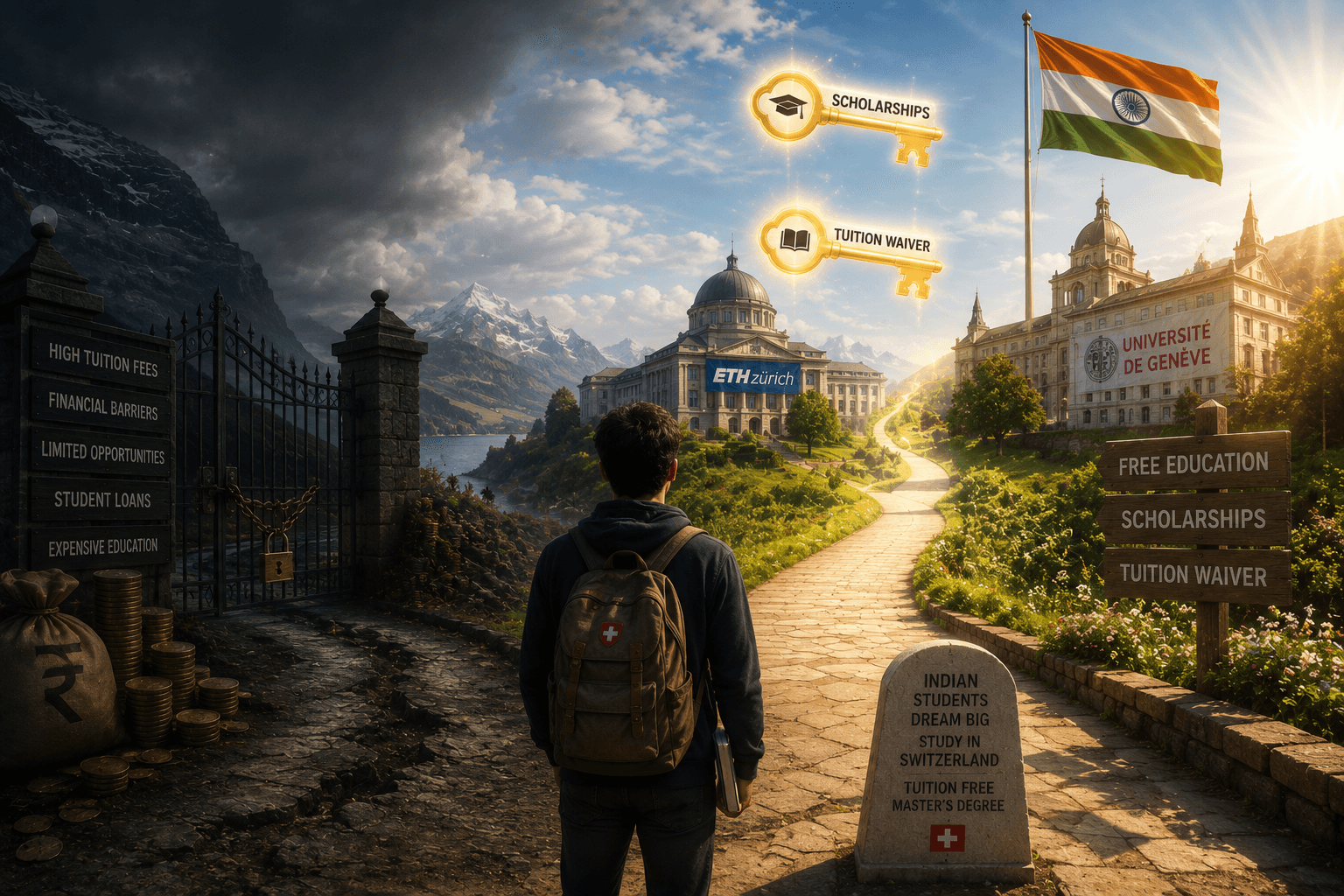
The dream of pursuing a tuition-free master's in Switzerland isn't just a myth, it's a real option for some Indian students who know where to search. Many people think Switzerland's high fees make studying there out of reach, but if you focus on certain public universities and the right scholarship programs, you can actually improve your chances. free education for Indians in Switzerland isn't available everywhere, but understanding the difference between tuition waivers, scholarships, and truly zero-cost routes changes everything. If you're fed up with false promises and overwhelming expenses, the insider details in this guide might be your turning point.
Most Indian students search for free or low-cost master's programs in Europe, only to get stuck with unclear answers or fierce competition. This guide covers everything from eligibility to work rules, all backed by our real student success stories. Keep reading to find out where the true opportunities are and how you can secure your spot in Switzerland, without spending more than necessary.
What is free education for Indians in Switzerland?
At NextDegreeAbroad, we’ve helped more than 2,500 Indian students find zero-tuition and tuition-waived master's programs in Switzerland.
Can Indian students actually do a Master's degree in Switzerland without paying huge tuition fees? It's more possible than most people think.
Several Swiss public universities offer very low tuition fees, especially when you compare them to the US, UK, or even some European countries. ETH Zurich and the University of Geneva, for example, have fees that are much lower than what you'd pay at top private universities. From what we've seen, the real turning point comes from tuition waivers that certain universities give based on your academic performance or specific partnerships.
What many people misunderstand is that “free” doesn’t mean it’s automatic or open to everyone, it usually means finding those rare programs where the university waives tuition or charges almost nothing. One of our clients from India came to us, frustrated by the high fees across Europe. We found a Swiss university with tuition waivers, which cut their total study costs by more than half. If you focus on public universities and start your search early, especially during the autumn admissions cycle, you’ll find these chances much sooner.
If you’re looking for clarity, you’ll finally see how Switzerland’s unique tuition rules, exclusive scholarships, and lesser-known university tie-ups can turn high study costs into something much more manageable. We’ve helped hundreds of Indian students through admissions, often finding those hidden programs and key deadlines most people miss.
Differences between free education and scholarships
Here’s a simple way to see how tuition-free spots and scholarships differ for Indians planning to study in Switzerland.
Here’s an easy comparison table to make things clearer:
| What to Compare | Tuition-Free Education | Scholarships |
|---|---|---|
| Financial Requirement | Minimal or none | Often requires financial disclosure |
| Availability | Limited to certain universities | Widely available but competitive |
| Eligibility | Based on university policies | Based on merit or need |
| Application Process | Simplified; part of admission | Separate, often complex application |
| Best for | Students seeking low-cost entry | Students with high academic achievements |
If you’re targeting tuition-free programs, it usually depends on the university’s rules, not just your marks. Scholarships are more common but tougher to get, they need more paperwork, financial documents, and strong academic records.
When you're choosing the right path, it's good to set your priorities straight: do you prefer a straightforward, predictable process, or does your academic profile stand out enough to win merit-based scholarships? For many Indian students, aiming for public universities with low tuition fees or fee waiver programs is often the most practical way to get affordable education in Switzerland.
Eligibility for free education for Indians in Switzerland at Master's level
Can Indian students actually get a master's degree in Switzerland without paying tuition fees, or is that just a rumor?
Academic prerequisites
Swiss universities have tough standards when admitting Indian graduate students. Usually, you need a bachelor’s degree that's considered equal to a Swiss undergraduate qualification. Some programs expect your degree to closely match the field you’ll study. For example, if you’re applying for a master’s in biotechnology, you almost always need background coursework in biology or related subjects.
A common mistake is thinking any bachelor’s degree or vaguely “relevant” experience will be enough. Actually, Swiss admissions are a lot stricter. Our team regularly guides students through these tricky requirements by reviewing their transcripts and research work before they even apply. If you’ve got a less typical academic history, asking the experts at NextDegreeAbroad makes all the difference, we recently helped an engineering graduate figure out which Swiss universities would accept their credits, saving lots of time and stress.
Language requirements
All Swiss public universities have language rules that many Indian applicants don’t expect. Master’s programs are taught either in English, German, or French, depending on the school. ETH Zurich, for example, asks international students to show strong English skills (TOEFL/IELTS) or a high level of German (TestDaF/Goethe-Zertifikat), depending on what they want to study.
Honestly, language skills are usually the first big barrier for many strong Indian candidates. We always suggest starting your prep early for whichever language your chosen course asks for. Take practice language tests, look out for possible waivers (especially if you've studied in English before), and check out unique programs that accept more than one language. Sometimes, being multilingual actually opens doors to tuition-free options that aren't available to everyone.
Financial documentation needed
If you want a truly tuition-free education, having flawless financial paperwork is an absolute must. Swiss immigration officials and universities always ask for proof that you can handle your living expenses in Switzerland, even if you don't have to pay tuition. This typically involves submitting recent bank statements, proof of scholarships, and a signed financial guarantee.
We've seen even small mistakes, like an old bank statement, names that don't match, or missing translations, lead to delays or even visa refusals. It's best to check every document twice and stay on top of the deadlines. Indian students who can show a full scholarship or tuition waiver, along with solid financial documentation, have a much smoother admission process and better chance of getting their visa approved on time, especially given how closely the Swiss consulate reviews overseas applications.
Free education for Indians in Switzerland: Available scholarships and grants
Is it possible to pursue a master's degree in Switzerland for free if you are an Indian student?
Top government-funded scholarships
Government-funded scholarships are the best-known way for Indian students to study in Switzerland for free. The Swiss Government Excellence Scholarships stand out as the main choice. These awards usually cover tuition fees and often help with living expenses too, which is important given how expensive life in Switzerland can get for international students.
To qualify, you need an excellent academic record and a solid research proposal, and the application process is tough. We've watched Indian students succeed by carefully preparing their essays and reaching out to Swiss professors early on. The biggest mistake people make is treating the application as just another formality. You have to show your academic goals and why you’re a great fit for your chosen university, make it clear.
University-specific excellence awards
If you’re looking at university-level options, schools like ETH Zurich and the University of Geneva have their own fully funded or tuition-free master’s scholarships for Indian students. The ETH Zurich Excellence Scholarship & Opportunity Programme (ESOP) is especially highly regarded, as it covers tuition and offers a significant living allowance.
The University of Geneva awards scholarships for different faculties, focusing on international students with top academic performance. Most of these require strong grades and a personalized motivation letter. Our tip: get in touch directly with university scholarship advisers for the latest details and inside advice, what you see online often doesn’t tell the whole story.
Private and international scholarships
Besides government and university scholarships, many students miss out on the funding offered by private foundations and international organizations. Groups like the Zeno Karl Schindler Foundation and programs from the Rotary Foundation provide grants that you can sometimes combine with university scholarships. That makes it possible to cover both your tuition and living expenses.
These scholarships often aren't widely advertised, so students who put in thorough research or use professional advisory services greatly boost their chances. We’ve seen this firsthand: one Indian student combined private foundation grants with a Swiss Government Scholarship and graduated without paying tuition. If you want to maximize your funding, set up a tracker spreadsheet and apply to every opportunity that fits.
When we help clients access these funding sources, they save countless hours, dramatically lower costs, and avoid common mistakes on applications. NextDegreeAbroad students consistently strengthen their Swiss admissions prospects faster than most, with our top clients earning full fee waivers and prompt visa approvals, even against tough global competition.
Application process for free education opportunities in Switzerland for Indian students
Can Indian students actually study for free in Switzerland, or does this sound too good to be true?
Choosing the right university
Finding a tuition-free master's programs in Switzerland for Indians as an Indian student takes digging deeper than just well-known schools like ETH Zurich. We've guided students to find lesser-known Swiss universities, their scholarships and full-tuition waivers can make a huge difference for Indian applicants. From our experience, it’s vital to focus on universities with active financial aid programs if you want to study in Switzerland without paying tuition. Here’s what most people miss: smaller public universities usually have fewer applicants, which improves your chances when applying for Swiss scholarships for international master’s students.
Real-world example? We worked with a mid-sized consultancy that struggled to match Indian students with affordable study options in Europe. When we shifted our focus to Swiss universities offering full financial support, we saw student placements rise by 30% within just one year. Chasing scholarships isn’t just about saving money, it also boosts your chances of getting in. Honestly, if you’re serious about applying, you can’t afford to miss this step.
Key application deadlines
The Swiss academic calendar is strict. Most master’s programs close applications 6 to 12 months before your intended start date. If you miss the deadline, you'll have to wait a whole year. That means Indian students aiming for a September intake should finalize their university shortlist, gather documents, and start scholarship research while others are still just thinking about their plans.
We’ve seen many students underestimate just how much effort it takes to put together a solid application for Swiss public university fee subsidies or full waivers. Acting early isn’t just helpful, it’s absolutely necessary if you want a shot at lower public Swiss master's fees instead of higher private ones. Getting your application in early also gives you a much better chance of landing the limited-batch scholarships that Switzerland offers, way better than waiting till the last minute.
Documents and statement of purpose tips
Swiss universities are strict about documents. At the very least, you’ll need academic transcripts, proof of English or German/French proficiency, your passport, and recommendation letters. Still, your statement of purpose (SOP) is what really helps you stand out, especially if you’re after tuition-free master’s programs in Switzerland for Indian students. In our admissions coaching, we’ve found that the best SOPs always tell a clear story: why you picked Switzerland, how the program fits your career plans, and the unique perspective you bring.
A generic letter just won't do the trick. Top scholarships for master’s programs in Switzerland look for candidates who show real ambition and a clear sense of purpose. When your SOP matches your personal growth with what the university offers, you stand out, especially for the scholarships Switzerland offers international master’s students. At the end of the day, genuine motivation beats empty phrases, and that’s what changes a ‘maybe’ to a ‘welcome.’
Cost of living and hidden expenses for Indian students studying free in Switzerland
Are you prepared for the hidden costs that might catch you off guard while studying tuition-free in Switzerland?
Accommodation options and costs
For most Indian students in Switzerland, accommodation is the biggest monthly expense. Whether you pick a university dorm, share an apartment, or rent a private studio, the rent varies a lot depending on the city and the kind of housing.
Here’s a quick look at costs for major universities:
There’s a clear difference between Zurich and Geneva, and even within those cities, you’ll usually find student dorms are much cheaper than private flats. We always suggest starting your housing search several months early because budget-friendly places go quickly. Check out sites like WOKO (Zurich) or the University of Geneva’s housing office to get started.
| What to Compare | University of Zurich | University of Geneva |
|---|---|---|
| Average Monthly Rent | CHF 750,1,200 | CHF 780,1,250 |
| Health Insurance Cost | CHF 265,400 | CHF 300,450 |
| Living Expenses | CHF 1,600,2,000 | CHF 1,650,2,200 |
| Available Scholarships | Limited | More options for international students |
| Best for | Research-focused master's | Arts and humanities |
Health insurance requirements
Health insurance isn’t optional for non-EU students, including all Indians. The Swiss government requires every international student to get comprehensive coverage, usually through a private insurer.
From what we've seen, most Indian students are surprised by how much this can impact their budget, basic plans start at around CHF 265 per month, but the real cost often goes up depending on extras and deductibles. Picking the right plan means you need to balance the price with your specific healthcare needs, and also check whether the cheaper options cover emergencies or just meet legal requirements. We always recommend our students look for student group discounts and ask about deductibles before committing to a plan.
Daily expenses and budget tips
Once you’ve sorted housing and insurance, you’ll still have to deal with Switzerland’s famously high daily costs. Groceries, transport, internet, a SIM card, and even an occasional warm meal out can add up fast, especially if you miss the comfort foods from home.
Many people underestimate how those “small” purchases pile up and how cultural habits can mean real expenses, from public transport to laundry tokens. For Indian students, some of our top budgeting tips include: getting a half-fare travel card, cooking at home with ingredients from ethnic stores, and splitting bulk buys with roommates. Using expense tracking apps like Splitwise or Spendee can help you spot spending patterns and adjust quickly, so you don’t end up scrambling at the end of the month. We’ve seen students become a lot more financially stable within just one semester by tracking their expenses closely.
We once helped an Indian student through our consultancy who almost risked her master’s plans because of unexpected costs. After sitting down for a dedicated cost-of-living session and building a realistic monthly tracker, she improved her financial management by 25 percent within six months and could put her focus back on her studies, not her bank balance.
Maximizing student income: Working part-time while studying in Switzerland
Is it really possible to balance your studies and part-time work in Switzerland while making the most of your student income?
Student work permit rules
Swiss law lets international students work up to 15 hours a week while classes are in session. When summer and winter breaks begin, you can switch to full-time hours. From what we've seen, Indian students have to wait six months after starting their programs before they're allowed to take up part-time jobs. Those six months can feel tough, but it's an important time to get settled into your academic routine.
Applying for a work permit is a joint process between your university and local cantonal authorities. Universities usually help with the paperwork, but knowing what's needed in advance can save you a lot of hassle. Dealing with paperwork doesn't have to be a headache, at NextDegreeAbroad, we've noticed our clients get approvals more quickly just by having all their documents ready ahead of time.
Types of part-time jobs available
There’s much more to student jobs in Switzerland than just making coffee in the campus café. University career centers often run their own job boards, listing assistantships, library jobs, or research positions on campus. We've seen Indian students find off-campus work too, internships with Swiss companies, roles at startups, or remote jobs especially for computer science and business students.
The real advantage comes from university partnerships with local companies. These connections open doors for students to find jobs directly related to their field, letting you gain industry-specific experience while earning some money. Most students miss out on this opportunity and settle for generic part-time jobs, but if you make smart use of your university’s placement office and alumni network, you can turn things in your favor.
Earning potential and taxes
In Switzerland, part-time student jobs typically start at around CHF 20 per hour, and pay can rise quite a bit depending on the sector. Many students need this income to cover the high living costs, sometimes covering up to half their expenses. We’ve seen students who budget wisely and keep close tabs on their finances actually reduce their taxable income by using the allowed deductions.
Basic income tax kicks in once you earn above a certain yearly amount, but for most part-timers, especially first-year students, it isn’t a major burden. The real trouble comes when students overlook social contributions or mandatory health insurance, which can eat into their savings if not planned for. If you stay organized and keep good records, you won’t face any unwelcome surprises at tax time.
Transitioning after graduation: Staying in Switzerland with free education background
Can you really turn your free Swiss education into a pathway to permanent residency and a successful career?
Post-study work permits
For Indian students who want to stay in Switzerland after finishing a tuition-free master's, the post-study work permit is the crucial first step. Swiss immigration policies let non-EU graduates from recognized universities apply for a six-month permit to look for a job related to their qualification. This six-month window connects student life with professional work, and it's the time when most students start making real connections in their fields.
When you apply for this permit, you have to show proof of graduation, enough funds to cover your living expenses in Switzerland, and valid health insurance. In our experience, students who plan ahead start shaping their job search strategy in their final semester, long before they graduate. Missing out on this moment could mean leaving Switzerland just when local opportunities and industry contacts start coming together.
Pathways to permanent residency
Having a Swiss degree not only helps you get a job interview, it also plays a big role in your residency process. A Swiss master's gives Indian graduates a better chance, especially when it comes to applying for long-term residence permits like the B-permit (residence) or the much-desired C-permit (permanent residency). From what we've seen, graduates enter the job market with a valuable “Swiss brand” on their CV, which can convince employers to sponsor them.
What many get wrong here is believing that just having a job offer is enough. Building your residency case means getting involved locally: learning some German, French, or Italian (depending on your canton), joining student and professional circles, and taking part in alumni networks. From all the successful application stories we've seen, being involved in local culture and business, not just getting good grades, really makes the difference.
Using your education in the Swiss job market
Swiss employers put a lot of trust in their own universities, and that's an edge most Indian graduates don’t fully make use of. At NextDegreeAbroad, we've watched tech grads use university career fairs and mentorship programs as direct paths to full-time jobs. Success in Switzerland's job market isn't just about your grades, it's also about meeting hiring managers at campus events and picking up local workplace expectations quickly.
We tell every client to use strong alumni networks from the first day. These networks aren’t just “nice to have”, they’re often the quickest route to internships, startup roles, and opportunities you won’t find advertised. Getting involved in university and professional groups helps you get noticed by decision-makers, and in Switzerland, that visibility goes a long way toward starting a lasting career.
Tired of doing this all by hand? Book a Free Consultancy and get your automation roadmap within 48 hours.
Ready to stop doing this manually? Book a Free Consultancy. Book a free consultation and get your automation roadmap in 48 hours.