The student visa process for Germany from India is notoriously complex, with multiple moving parts that can easily trip up even the most prepared applicants. Many Indian students get confused about visa categories, blocked account requirements, and timelines. Missing just one step can cause serious delays and put your study plans at risk.
At NextDegreeAbroad, we have successfully guided over 3,000 Indian students through the German student visa process in the past five years, helping them navigate critical requirements and avoid common pitfalls.
What is the student visa process for Germany from India?
Stuck refreshing the VFS appointment page and still not sure whether you need a visa, how much blocked account money is required, or how long Germany will take to decide? You're not alone. The student visa process for Germany from India has multiple moving parts, and getting one step wrong can cost you weeks.
Key stages explained
The Germany student visa process runs in a fixed sequence, and the order matters more than most people expect. Skipping ahead or booking under the wrong category is the most common mistake we see from Indian applicants.
Here's the full process in order:
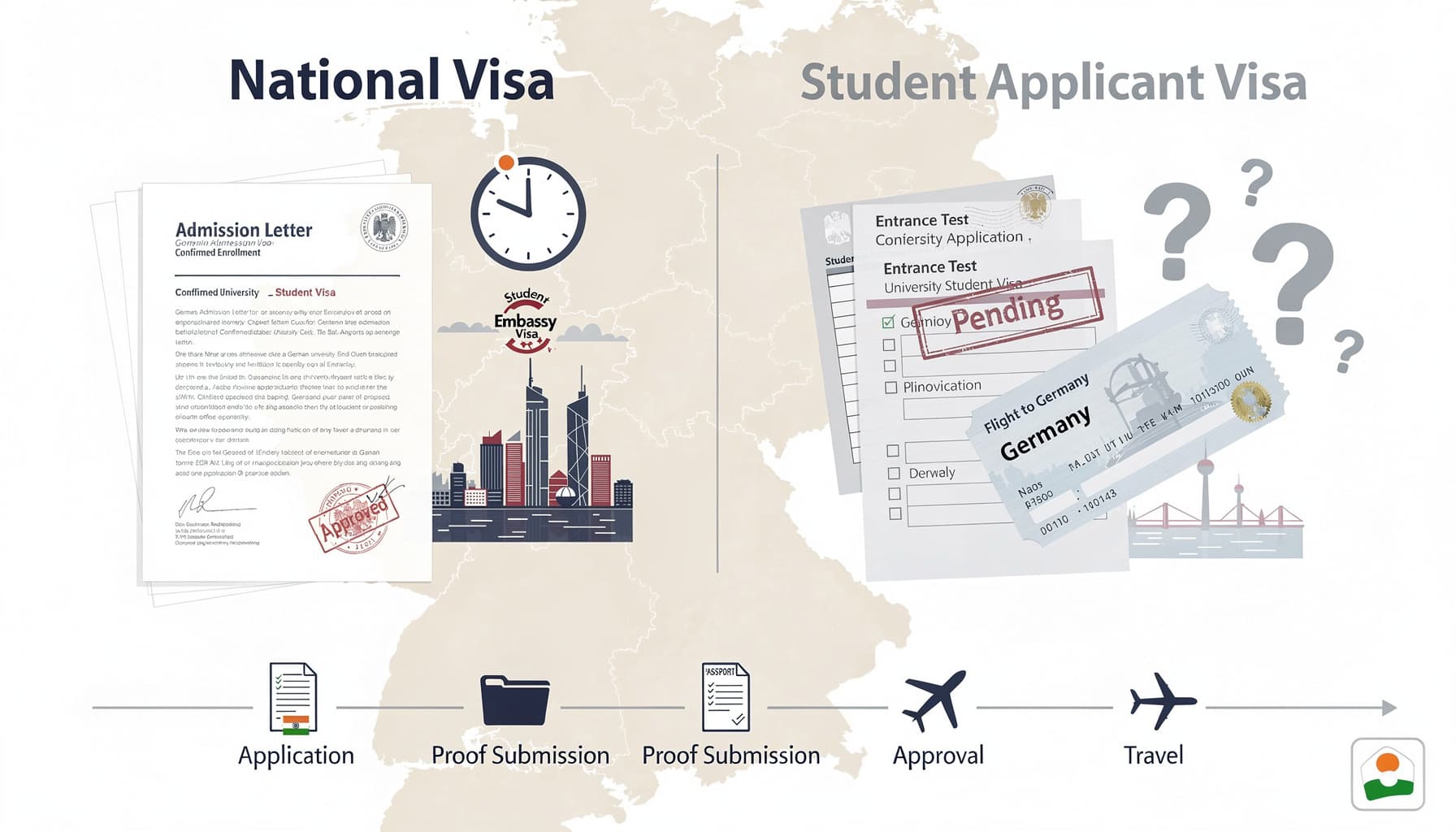
- Confirm your visa type: Student Visa (admission letter in hand) vs Applicant Visa (still awaiting decisions)
- Get your prerequisites in place: APS certificate, university admission letter, finances via blocked account or sponsor, travel health insurance, and accommodation plan
- Book your Germany visa appointment in India through VFS under the correct category
- Prepare all documents and forms, including photographs, copies, declarations, and pay the applicable fees
- Submit at VFS and complete biometrics on the same visit
- Track your application and respond promptly to any additional document requests from the embassy
- Collect your passport, verify every visa detail carefully, then plan your travel
- After arrival: complete city registration (Anmeldung) and convert to a residence permit as required
I had a student last year who booked his VFS appointment before his APS certificate was ready , he had to cancel, rebook, and ended up losing 9 weeks. One avoidable step out of sequence, and his entire intake shifted.
What most people get wrong here is treating VFS as the decision-maker. VFS only collects your documents and biometrics. The German embassy or consulate makes the actual visa decision.
In our experience, the biggest time-waster is booking an appointment under the wrong visa category and having to restart. One student we worked with in Ahmedabad had an admission letter from a public German university but was unsure whether to apply as a Student Visa or Applicant Visa applicant. The team mapped the correct pathway immediately, built a full checklist around the APS certificate, blocked account, insurance, and financial proof, and secured a VFS slot within 12 days through cancellation monitoring. Biometrics cleared on the first visit. Visa issued 24 calendar days after submission. The student landed in Germany 8 days before course start.
Your checklist is only as good as your follow-through. Every week before your visa submission matters , stay consistent, keep documents updated, and don't let small gaps pile up into last-minute chaos. That discipline is what separates students who get their visa on time from those scrambling at the finish line.
Expert Note: If your degree certificate has a different name spelling from your passport, include an affidavit and a notarized explanation letter to avoid embassy queries.
Key Takeaway: Double-check the visa category before booking to avoid losing weeks on avoidable rebooking.
Missing even one item from the German student visa checklist, like blocked account proof or APS, can force you to rebook your VFS appointment and lose weeks.
Academic Requirements
What most applicants get wrong here is document order. Your admission letter, APS certificate, mark sheets, and degree certificate must follow the exact sequence your VFS checklist specifies , not the order that feels logical to you.
Here's your core academic document set:
- APS certificate (if applicable to your qualification route)
- University admission letter (note if conditional)
- All semester/year mark sheets
- Degree certificate or provisional certificate
- CV and SOP/motivation letter (if used to explain gaps)
Build one PDF folder in that same order and keep originals ready for verification.
Financial Proof and Blocked Account
The blocked account is what the German embassy expects to see , there's no real workaround. I've reviewed blocked account confirmations for over 60 students from Ahmedabad alone, and the most common rejection trigger every single time was a name mismatch between the confirmation letter and the passport. Your document must show your full name exactly as it appears on your passport, the deposit amount meeting the current annual requirement, and clear access conditions.
Scholarships and formal obligation letters are alternatives, but they carry more scrutiny. Don't book biometrics until your blocked account confirmation shows the full required amount and your name matches your passport exactly.
Language Proficiency Criteria
German-taught programs typically require TestDaF, DSH, or Goethe certification. English-taught programs may accept IELTS or TOEFL, though requirements vary by university and some admits are conditional on language completion.
Match the exact test and minimum score to your program's admission letter and print the score report for the visa file.
Medical and Insurance Documents
Travel insurance for entry and German-compliant incoming student insurance are not the same thing. Many Indian applicants submit travel insurance and get flagged, because the consulate wants proof of coverage valid inside Germany for your full stay period.
Carry an insurance certificate that explicitly states coverage in Germany and the coverage period aligned to your planned entry date.
I've seen students lose their visa appointment slot in the final week because one insurance document said "valid for travel to Germany" instead of "valid within Germany" , that single phrase cost them a rebooking and a three-week delay on their intake.
Expert Note: Make your document photocopies on A4-size paper regardless of their original size, as VFS and German missions reject non-standard formats.
Key Takeaway: Assemble documents in the exact order listed on your VFS checklist to avoid delays during submission.
Step-by-Step Guide: Student Visa Process for Germany from India
Do you know the exact week you must book your German student visa appointment in India so your university start date is still realistic?
Most students don't. They get the admission letter, feel relieved, and lose three critical weeks doing nothing. That gap is where deferrals happen.
University Admission and Offer Letter
Before you touch a visa form, your admission status must be airtight. You need an unconditional offer letter, or a conditional one with a clear, documented plan showing every condition is met. Know your intake date, program name, campus, and admission status well enough to state all four in a single sentence.
APS certification applies to Indian students with Indian academic qualifications. I've seen students at my Ahmedabad office book their visa appointment first and discover the APS requirement later, costing them 6 weeks and their original intake. If your university or program requires it, factor in 4 to 6 weeks minimum and start it before anything else.
Takeaway: If you can't state intake date + program name + campus + admission status in one line, pause and fix this first.
Document Preparation Timeline
Work backward from your course start date, not forward from today. At 12 to 16 weeks out, open your blocked account and arrange the required funds. Germany's blocked account requirement sits at 11,208 euros per year as of 2026 , that's the first number a visa officer checks, so don't leave it sitting incomplete.
At 8 to 12 weeks out, finalize visa-compliant health insurance and confirm your accommodation plan. Between 4 and 6 weeks out, print, notarize, and attest documents as needed. One week before your appointment, go through every document once more and prepare duplicate photocopy sets in submission order.
I've seen students push everything to 6 weeks before their appointment thinking that's enough , then hit APS delays, courier holdups, or a translation rejection, and suddenly the intake is gone. Start at 16 weeks. That buffer isn't comfort; it's your safety net.
Here's the step-by-step process at a glance:
- Get admission/offer letter and confirm intake start date
- Complete APS requirements (if applicable)
- Arrange finances (blocked account/education loan/sponsor proof as applicable)
- Get visa-compliant health insurance for the application stage
- Prepare documents in submission order + photocopy sets
- Book visa appointment and submit biometrics/file
- Prep interview answers mapped to documents (course, funds, intent)
- Track status and keep travel plans flexible until approval
Booking the Visa Appointment
Depending on your city, you'll book through the German mission directly or via VFS. Appointment availability varies sharply across Delhi, Mumbai, Chennai, and Bangalore. When slots look empty, check daily, stay flexible on city, and be ready to submit within 7 to 10 days if an early slot opens.
I've seen students grab a slot three weeks out, then scramble because their blocked account took longer than expected. An early slot means nothing if your APS is still processing or your blocked account confirmation hasn't landed.
Takeaway: Book only when APS, admission, and finances are on track and you can submit within 7 to 10 days if you get an early slot.
Visa Interview Preparation
The interview isn't where students fail because of nerves. It's where they fail because their answers don't match their documents. Visa officers check six areas: program choice, university choice, academic fit, finances, post-study intent, and travel and insurance plan.
Prepare 10 core answers. For each one, identify three documents you'd show if the officer pushed back. A student from Ahmedabad we worked with mapped every interview answer directly to his SOP and blocked account confirmation, submitted his file 9 weeks before his course start, and reached Germany with a two-week buffer before orientation.
Takeaway: Prepare 10 answers + 3 proofs per answer, the document you will show if asked.
Mapping each visa requirement to a specific document in your folder is not just administrative, it's strategic. I've seen students lose confidence mid-interview simply because they couldn't locate the right paper at the right moment.
Expert Note: If the interview officer conducts part of the conversation in German, answer in German if you claimed proficiency to avoid doubt about your language certificate.
Key Takeaway: Practice your 10 main interview answers with related documents in hand to improve your confidence and consistency.
Visa Fees, Timelines, and Success Rates for Indian Applicants
How long will you really wait for a German student visa from India, and how much money must you prove, before you book your VFS appointment?
Current Visa Fee Structure
The official German national visa fee for students is 75 EUR. You'll pay this in INR equivalent at your VFS Visa Application Centre, plus VFS service charges and optional add-ons like document handling or SMS alerts. These service fees are set by VFS, not the German mission, so they can shift without much notice.
Check your specific VFS centre page the same week you book your appointment. A student I guided from Ahmedabad paid ₹7,400 all-in at submission , another student applying through a different city that same month paid noticeably less because their centre had a lower service fee tier. Never assume the final number until you've checked that week's schedule.
Processing Timeline breakdown
Think in two separate clocks. First: days to land a VFS appointment slot. Second: days from biometrics submission to visa decision. Peak intake months like October and April stretch both timelines hard.
An engineering student from Gujarat got their winter intake visa in 5.5 weeks after biometrics by keeping every document ready before the appointment, not after. They monitored VFS cancellations and moved their slot up by 18 days. Reverse-plan from your course start date with at least a 6-week buffer for any re-submission risk.
Expert Note: If your application is flagged for "further documents required," upload missing files via the visa portal within 48 hours to avoid having your case moved to the bottom of the processing queue.
Key Takeaway: Always allow a 6-week buffer between visa application and your German university start date.
Recent Approval Rates for Indian Students
No verified source tracks German student visa approval rates for Indian applicants year by year. Anyone quoting a precise percentage is guessing. Don't make decisions based on those numbers.
What actually moves the needle is your controllables. Weak financial proof, missing health insurance, inconsistent course rationale, and incorrect document formats are the real reasons applications stall or get refused. I had a student from Ahmedabad last year whose entire file was solid , except her blocked account certificate showed a balance that was €200 short of the required amount. That single gap pushed her timeline back by 3 weeks. Build a decision-ready file before your biometrics day and you cut your resubmission risk significantly.
Ready to stop doing this manually? Book a Free Consultancy. Book a free consultation and get your automation roadmap in 48 hours.